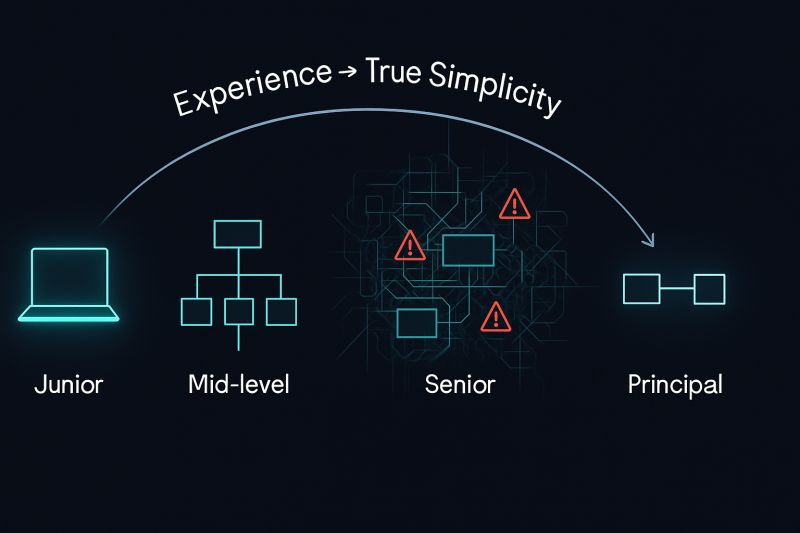
System overview
Junior box: One GPU. Every model, every request shape, every hope. When it dies, buy a bigger box.
Mid platform: Kubernetes plus a second replica. The OOM is now a restart policy. The allocator still cannot place the next KV block.
Senior stack: Tensor parallel, a custom scheduler, three dashboards, a design doc with four kinds of parallelism.
Principal system: The SLO is met. Half the GPUs are gone. Two services were deleted. The queue was the product.
What I observed
The joke writes itself because I have sat in the rooms.
Junior AI engineer: throw everything on the box.
Mid: add Kubernetes so the OOM restarts politely.
Senior: four kinds of parallelism and a design doc.
Principal: the SLO is met with half the GPUs because they measured the queue, not the model.
I would rather see one good trace than a new service mesh.
The argument
Over-engineering is how we hide that we never wrote down the bottleneck.
Each rung on the ladder adds a thing you can put on a slide. None of those things require you to say: wait time, KV lease, batch mix, or interconnect stall. So the org buys the next abstraction and the users keep waiting.
Principal work looks like subtraction because the scarce resource was already there. You cannot parallelize your way out of a queue you refuse to measure. You cannot mesh your way out of an allocator that is fragmented. Deleting a replica that existed to comfort the dashboard is the unglamorous version of seniority.
Finding 1: Replicas and meshes restart the same failure
Claim. Orchestration without a named bottleneck converts a crash into a loop.
Evidence. The mid-level move in this ladder is Kubernetes plus a second replica. The failure mode does not change: the box still OOMs. It just comes back. The field note’s punchline is “polite”, the process manager is healthier than the request.
Explanation. If the limiter is KV residency or a hostile prefill/decode mix, a new pod copies the same lease math onto another GPU. You have bought a second copy of the mistake. A service mesh then gives you retries, which multiply work into the same full queue.
Implication. Do not promote the restart policy to an architecture. Trace one request first.
Finding 2: Parallelism without a queue measurement is a design doc
Claim. Four kinds of parallelism are not a diagnosis. They are a menu.
Evidence. The senior rung in the joke is tensor parallel, a custom scheduler, three dashboards. The principal rung is deletion: half the GPUs, two services gone, the queue treated as the product.
Explanation. Tensor and pipeline parallelism move bytes across a fabric. That is the right lever when the model does not fit or the batch cannot live on one card. It is the wrong lever when requests are waiting, KV is fragmented, or you are mixing a 12k prefill with a chat completion. Dashboards that show SM busy will ratify the senior design. Users will not.
Implication. Write the bottleneck in one sentence before you draw the parallelism diagram. If you cannot, you are still junior with a bigger vocabulary.
The mental model
Experience should collapse the graph, not decorate it.
Junior     : just throw everything on one GPU
Mid        : Kubernetes + a second replica
Senior     : tensor parallel, custom scheduler, three dashboards
Principal : delete two services. the queue was the product.| Rung | Typical move | What it actually changes | Unit of progress |
|---|---|---|---|
| Junior | Fill the box | Occupancy of one GPU | models / GPU |
| Mid | Replica + restart | Crash interval, not the limiter | pods |
| Senior | Parallelism + dashboards | Communication tax, slide count | GPUs, docs |
| Principal | Delete and measure | Queue depth and SLO | wait (ms), goodput |
“Half the GPUs” is the field-note punchline (a relative outcome after measuring the queue) not a published capacity study.
Practical guidance
- Write the bottleneck in one sentence before you add a component.
- Prefer one request-level trace over a new mesh.
- Treat OOM as an allocator story (KV, fragmentation) until proven otherwise.
- Do not buy parallelism until you know what does not fit.
- Reward deletion that holds the SLO. That is the senior signal.
Limitations
This is a teaching ladder, not a job-level rubric and not a controlled experiment. Teams skip rungs; some juniors measure queues and some principals collect dashboards. “Half the GPUs” is an observed pattern when the queue was the product, not a guarantee. Kubernetes and tensor parallelism are real tools. The critique is using them as a substitute for naming the limiter.