System overview
Request path: HTTP request through gateway, router, scheduler, engine, GPU. If you cannot draw this, you are collecting tools.
Two workloads: Prefill (compute-bound, writes KV) and decode (memory-bound, rereads KV). “Inference” is both.
Memory chapter: Weights plus KV plus fragmentation. smol-vLLM exists so you can read paging without a 200k-line engine.
Queue chapter: Batching, admission, SLOs. RelayServe is the serving-facing slice.
Hardware chapter: PMPP notes, then CUDA, kernels, compilers, when you know which millisecond you are buying.
What I observed
If I had to build one skill roadmap, I would not start with CUDA.
I would start with the request path. Then the two workloads hiding inside “inference.” Then memory. Then the queue. Then parallelism. Kernels last.
The pile-of-tools version produces people who can quote FlashAttention and cannot say why their p99 moved.
The argument
A tool list feels like progress because each name is searchable. A sequence is progress because each step tells you what the next lever is for.
CUDA is a way to buy a millisecond once you have named it. If you have not walked a request from the gateway to HBM, you do not know whether that millisecond is in the kernel, the queue, the cache, or the fabric. FlashAttention is a real paper. Reciting it is not a diagnosis.
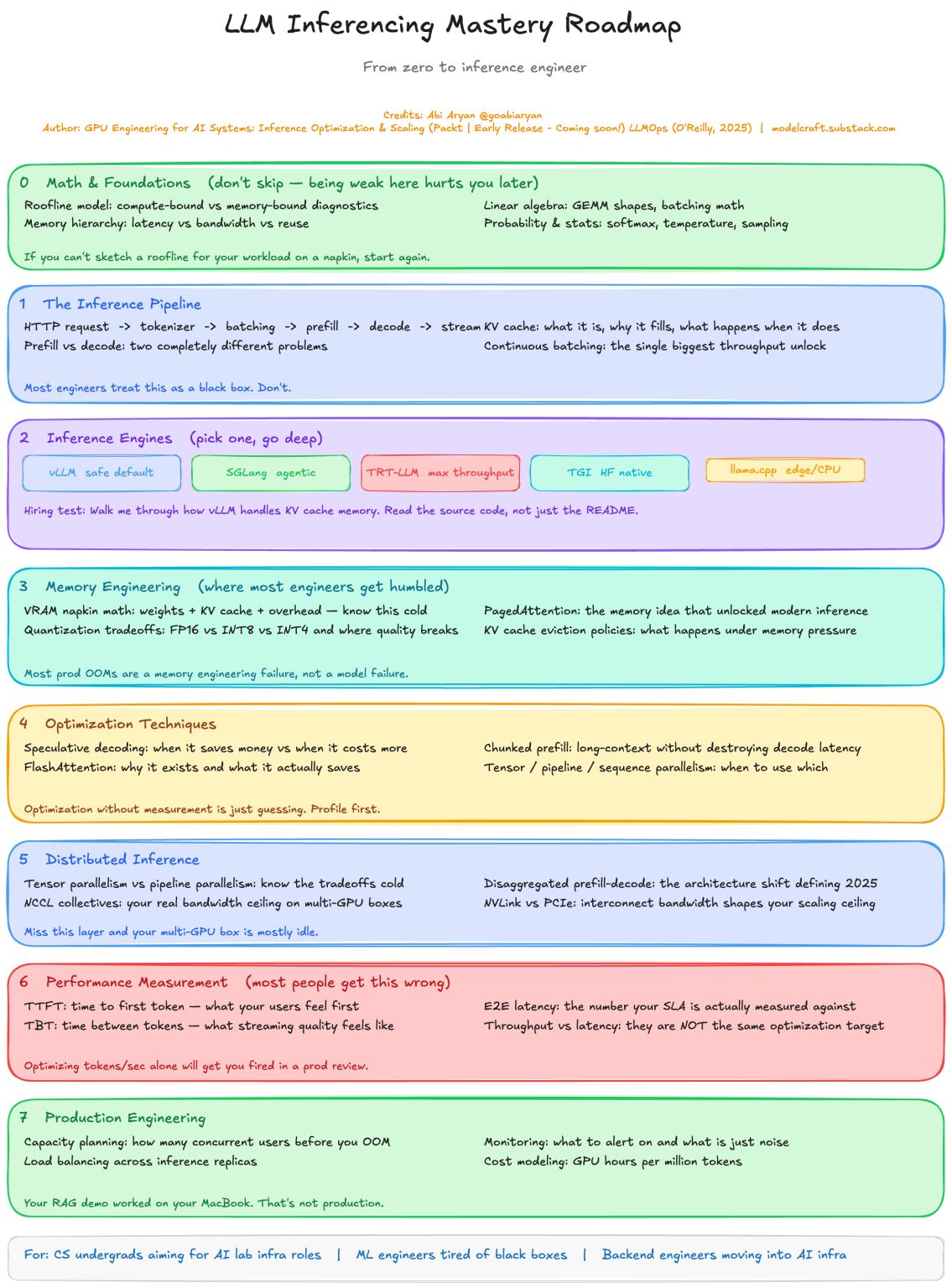
The visual roadmap on this page adds foundations, engines, measurement, and production around the same spine. The spine does not change: path, phases, memory, queue, then hardware.
Finding 1: Tools without a path cannot explain p99
Claim. Knowing engine names and kernel papers does not transfer to explaining why tail latency moved.
Evidence. The failure mode in the field note is specific: people quote FlashAttention and cannot say why their p99 moved. That is a sequence error, not an intelligence error. They started at the last lever.
Explanation. p99 is usually queueing, batch composition, KV pressure, or a long prefill sharing a batch with interactive decode. A kernel improvement shows up after those are stable. If your first month is CUDA, you will look for a kernel every time the tail moves.
Implication. Teach the path until the student can point at the hop. Then hand them PMPP.
Finding 2: Kernels are a purchase, not a starting point
Claim. CUDA belongs at the end of the roadmap because it is how you spend effort on a named millisecond.
Evidence. The sequence I keep writing is six steps, kernels last. RelayServe and smol-vLLM are the serving chapter. PMPP is the hardware chapter. That split is intentional: most production pain I see is not “we needed a fused attention kernel on day one.”
Explanation. Prefill vs decode tells you whether you are compute-bound or bandwidth-bound. KV as a first-class resource tells you whether HBM is the limiter. Batching and SLOs tell you whether you have a queue. Parallelism tells you what to do when one GPU is not a machine. Only then is a kernel the cheapest remaining buy.
Implication. If someone asks “what should I learn next” and you say “CUDA” before they can draw the path, you just sold them the wrong week.
The mental model
One spine. Everything else is a bookmark.
1. Request path (gateway → engine → GPU)
2. Prefill vs decode
3. KV cache as a first-class resource
4. Batching, queues, SLOs
5. Parallelism (data / tensor / pipeline / expert)
6. Then: CUDA, kernels, compilers| Step | What you can name after it | Unit you start using |
|---|---|---|
| 1. Request path | Which hop is lying | hops |
| 2. Prefill vs decode | Which phase owns the time | ms / phase |
| 3. KV cache | What is leasing HBM | bytes, pages |
| 4. Queue + SLO | What users feel | TTFT, TPOT, depth |
| 5. Parallelism | What does not fit on one GPU | GPUs, comms |
| 6. Kernels | Which millisecond you are buying | ms, roofline |
Practical guidance
- Draw the request path on paper before you open a CUDA tutorial.
- Explain prefill vs decode without saying “the model runs.”
- Treat KV bytes as a capacity input, not an implementation detail.
- Attach every optimization to a metric: TTFT, TPOT, or goodput.
- Read PMPP and write a kernel only when you can name the millisecond.
Limitations
This is a teaching sequence from hiring, the Maven cohort, and serving work, not a validated curriculum study. People who already live in compilers can start later in the list. Engine choice (vLLM, SGLang, TensorRT-LLM) changes the labs, not the spine. The cover image is a broader mastery map; the six-step list is the argument I will defend in a room.